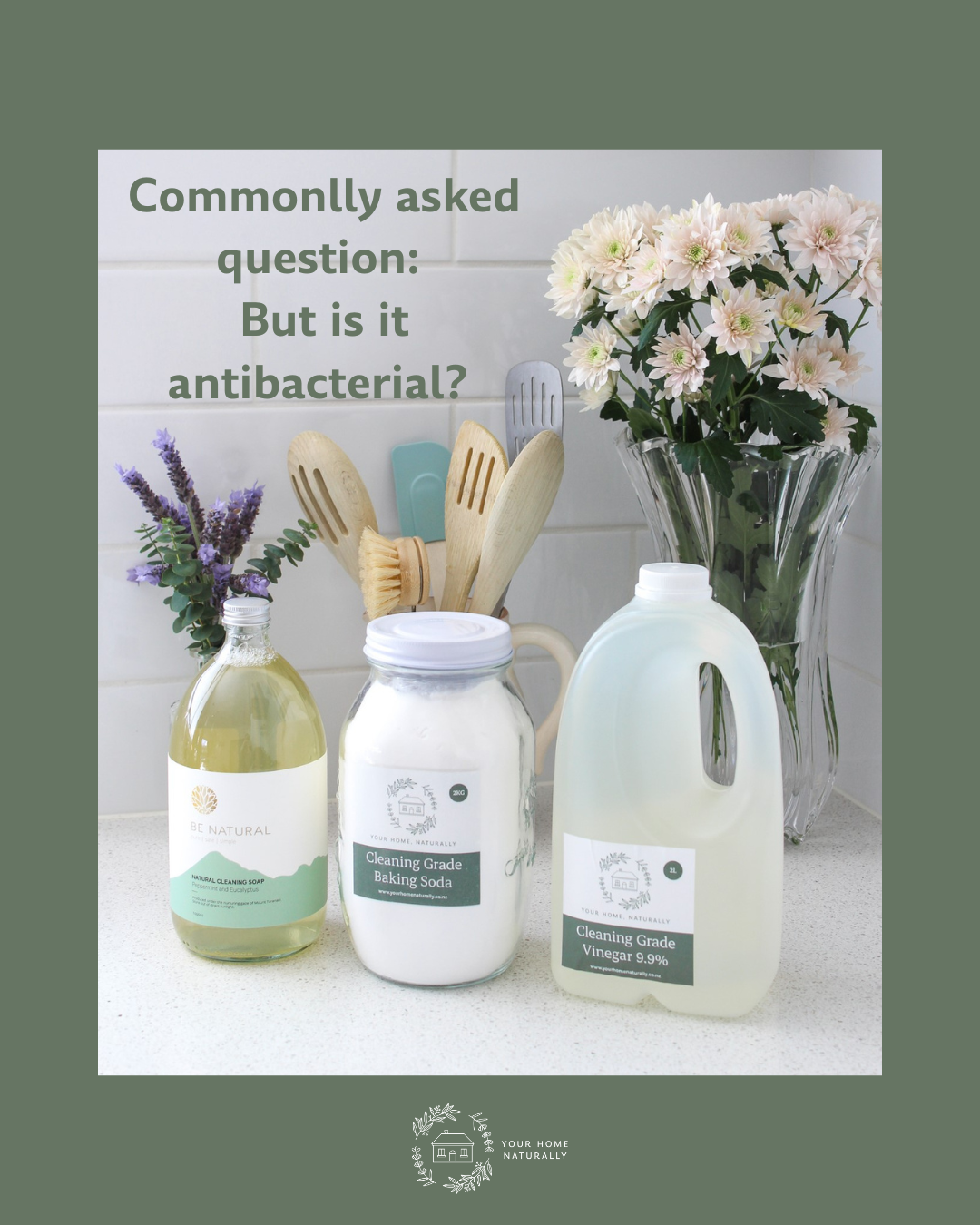
Commonly asked question: But is it antibacterial?
I recently had a conversation with a customer who asked: “Is soap antibacterial?” The short answer: No — but that doesn’t mean it’s not doing its job. In fact, for most homes, plain soap and water are enough to remove illness causing germs.
Here’s the longer version:
What soap actually does
A drop of ordinary soap, lathered and rinsed with water, works by loosening and lifting bacteria, viruses, and grime so they can be washed away. It doesn’t always kill germs in the way a disinfectant would but for everyday home cleaning, it removes them effectively.
What antibacterial and disinfecting labels mean
The word “antibacterial” usually means the product contains chemicals designed to kill or stop the growth of bacteria.
“Disinfect” refers to chemicals or processes that destroy or inactivate microorganisms (including bacteria and viruses) on surfaces.
These terms sound reassuring but they are marketing loaded and can mislead us into thinking our home needs hospital level germ control.
Do we need antibacterial or disinfecting strength at home?
Most household cleaning tasks don’t require products strong enough for a hospital surgery room. What you really need is a product that cleans; that is, removes dust, dirt, grime and a large portion of germs. Over relying on disinfectants adds unnecessary synthetic chemicals to your home environment. Many of these are linked to skin irritation, hormone disruption, and respiratory issues.
Why we believe we need “99.9% germ killing” products
It comes down to fear and marketing. We’ve been conditioned to think that if it doesn’t say “kills 99.9% of germs,” then it isn’t safe. Big cleaning brands promote antibacterial/disinfecting labels to make us feel safer. But that doesn’t always equate to being safer. Just read the back label and it will say 0800 Poison Centre.
The truth is: simpler is better
Natural cleaning staples like baking soda, vinegar and castile soap have been around for generations. Their formulas are time tested. What’s changed is our belief system, pushed by clever marketing, that only strong chemicals do the job.
Essential oils such as peppermint, eucalyptus, lemon, lavender, tea tree and “Thieves” blends have long been recognised for their antibacterial, antiviral and antiseptic properties. They are, quite literally, the original cleaners.
In the world of natural cleaning, these oils provide a meaningful alternative to harsh chemicals, when used carefully and thoughtfully. You don’t need a product labelled “antibacterial” or “99.9% germ kill” to have a safe, effective home clean. You need something that removes dirt and grime, minimises toxins, and supports your family’s health and the environment.
At Your Home, Naturally, we say: Get back to basics. A consistent clean with safe, natural products is enough to maintain a healthy home environment.
Final thoughts
Use Castile Cleaning Soap (a natural multipurpose cleaner) to clean.
Reserve disinfectants for very particular use cases (e.g., after illness, or in heavy-duty sanitation scenarios). Cleaning Grade Vinegar 9.9% is a great disinfectant.
Choose products with minimal toxic load such as our Cleaning Grade Baking Soda.
Remember: Cleaning = removing ≠ always. Disinfecting = killing.
Your home doesn’t need to be a sterile hospital ward, it just needs to be a safe, clean, comfortable place your whanau can thrive.
Better for your health, better for the environment.